
MQTT & MQTTS Explained: The Smart and Secure Communication Protocols Powering Modern IoT
In today’s fast-growing IoT world, devices must communicate smoothly, even with low power or unstable networks. From smart homes to industrial automation, millions of devices rely on lightweight protocols to exchange data in real time.
A powerful technology that makes this possible is MQTT and its secure encrypted version, MQTT.
 What Is MQTT?
 What Is MQTT?
MQTT (Message Queuing Telemetry Transport) is a lightweight messaging protocol used for communication between IoT devices. It is designed for low-power, low-bandwidth, and unstable network environments, making it one of the most popular protocols in the IoT industry.
Why MQTT Is Popular
- Low bandwidth usage
- Works even on weak or unstable networks
- Ideal for battery-powered IoT devices
- Scales easily from a few devices to thousands
- Very fast and efficient for real-time updates
Teams at Jenex Technovation also use MQTT for embedded systems, cloud IoT platforms, and smart device communication.
What Is MQTTS?
 What Is MQTTS?
MQTTS is simply MQTT running over TLS/SSL encryption.
It is not a different protocol it is MQTT with security enabled.
When encryption is applied, MQTT becomes MQTTS, ensuring that data is protected during transmission.
MQTTS Provides
- End-to-end encrypted communication
- Device authentication using certificates
- Protection from hacking or data tampering
- Secure transmission over public or open networks
In short:
 MQTT = Lightweight, fast IoT communication
 MQTTS = MQTT + TLS/SSL security
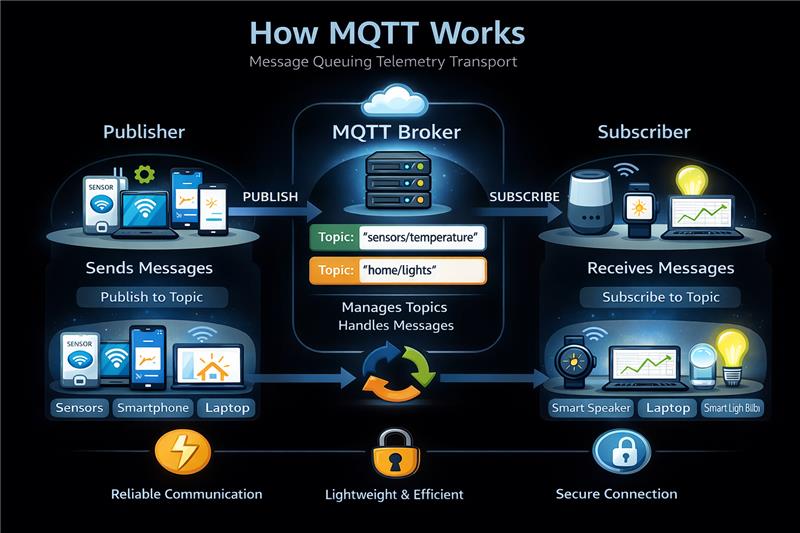
How MQTT Works
 How MQTT Works
MQTT follows a very simple and efficient architecture:
1. MQTT Broker
A central server that receives and distributes messages.
Examples: Mosquitto, HiveMQ, EMQX, AWS IoT Core.
2. Publishers
Devices that send data, such as sensors sending temperature updates.
3. Subscribers
Devices or applications that receive the messages published to specific topics.
4. Topics
Channels used to organize communication.
Examples:
- home/sensors/temperature
- factory/machine/status
- vehicle/truck/location
Message Flow: Publisher → Broker → Subscriber
The Publish/Subscribe Model
 The Publish/Subscribe Model
Instead of traditional request-response, MQTT uses the publish/subscribe (pub/sub) communication method.
- Devices publish messages to a topic
- Subscribers receive updates instantly
- The broker manages message distribution
This model allows thousands of devices to communicate efficiently without overloading the network.
Where MQTT Is Commonly Used
 Where MQTT Is Commonly Used
 Smart Home Systems
 Smart Home Systems
- Smart lights
- AC controllers
- Smart locks
- Motion & temperature sensors
Industrial IoT
 Industrial IoT
- Machine health monitoring
- Factory automation
- Predictive maintenance
Automotive & Transportation
 Automotive & Transportation
- EV battery status
- Vehicle tracking
- Telematics
Healthcare IoT
 Healthcare IoT
- Wearables
- Patient monitoring devices
- Smart medical equipment
Smart Agriculture
 Smart Agriculture
- Soil moisture sensors
- Weather stations
- Air quality & pollution monitoring
Embedded Systems & Microcontrollers
 Embedded Systems & Microcontrollers
- ESP32 / ESP8266
- Arduino
- STM32
- Raspberry Pi
MQTT works perfectly for sensor-based communication, while MQTTS ensures security when handling private or sensitive data.
Conclusion
MQTT has become a backbone of modern IoT communication because it is lightweight, fast, scalable, and perfect for real-time updates.
When security is required, MQTT simply uses TLS/SSL to provide encryption becoming MQTTS.
Together, these features make MQTT the ideal choice for smart homes, industries, healthcare, agriculture, vehicles, and embedded systems worldwide.