
The Strategic 2026 Cost of IoT Development in the USA: A Technical ROI Analysis
Navigating the financial landscape of hardware-software integration requires more than just a line-item budget. As we move through the current year, the 2026 cost of IoT development in the USA has become deeply tied to two major pillars: cyber-resilience and edge intelligence. At Jenex Technovation, we work with US-based firms that are moving away from disposable technology toward permanent hardware solutions. This shift fundamentally changes how stakeholders calculate their initial investment versus their long-term operational savings.
1. The Evolution of IoT Economics in 2026
In previous years, development was often treated as a linear process. Today, the 2026 cost of IoT development in the USA reflects a holistic ecosystem approach. We are no longer just building connected devices; we are engineering Agentic IoT systems capable of autonomous data processing at the edge. For a Silicon Valley startup or an East Coast industrial enterprise, the budget must now account for high-speed signal integrity, advanced thermal management, and multi-layer security protocols.
2. Hardware Engineering: Beyond the Prototype
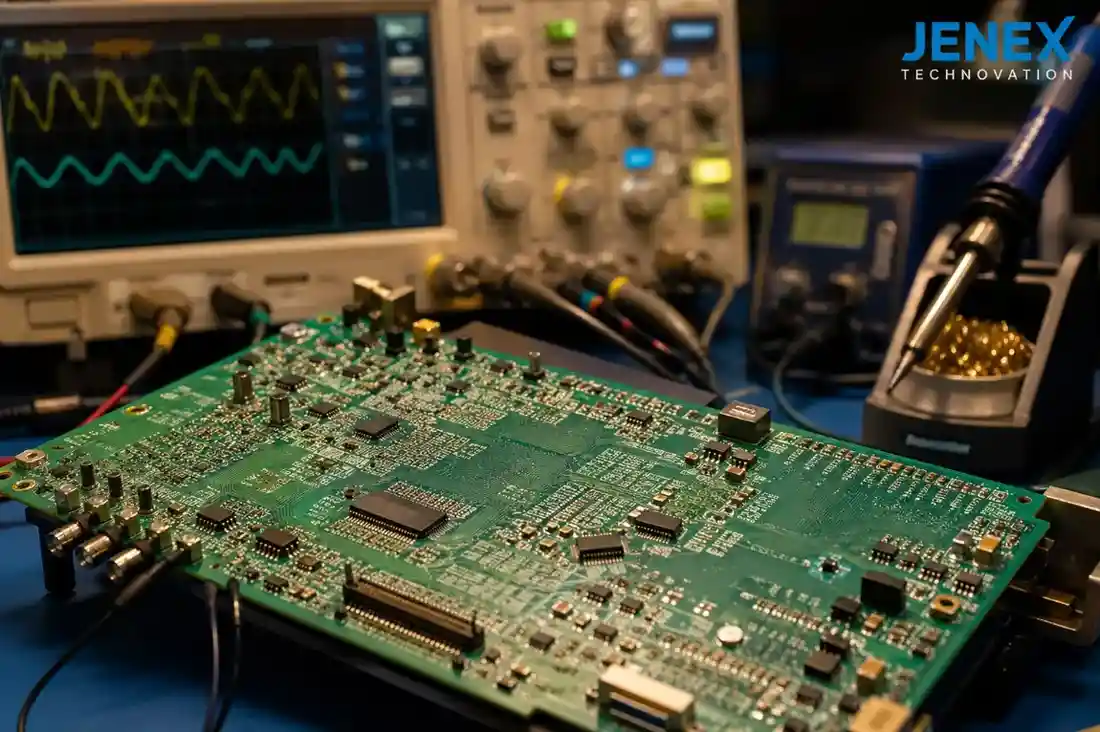
The hardware component of any smart product is where the 2026 cost of IoT development in the USA begins to take shape. Engineering a reliable PCB (Printed Circuit Board) in today’s market involves navigating complex global supply chains and strict regulatory standards.
Design for Manufacture (DFM): At Jenex Technovation, we emphasize DFM in the early stages. While this may slightly increase the initial design cost, it drastically reduces the cost per unit during mass production.
Signal and Power Integrity: As microprocessors become faster and more compact, the risk of interference increases. Rigorous testing using oscilloscopes and spectrum analyzers is essential.
Compliance and Certification: The Federal Communications Commission (FCC) has introduced more stringent guidelines for 2026. Budgeting for FCC, CE, and RoHS certifications is mandatory to ensure your product can legally enter the USA and international markets.
3. Firmware: The Intelligence Layer
If hardware is the body, firmware is the nervous system. A significant portion of the 2026 cost of IoT development in the USA is allocated to low-level systems programming. Developers are increasingly moving away from Bare Metal programming toward robust embedded hardware design using Real-Time Operating Systems (RTOS) like Zephyr or FreeRTOS.
The complexity of firmware directly impacts security. In 2026, the USA market demands Root of Trust (RoT) implementation. This ensures that every piece of code running on your device is authenticated, protecting your intellectual property and user data from sophisticated cyber-attacks.
4. Software and Cloud Infrastructure
The Software side of the 2026 cost of IoT development in the USA covers everything from the mobile application to the cloud-based data lake. As a premier app development company in New York, Jenex Technovation understands that the UI/UX must be as reliable as the physical hardware.
Cloud TCO: Total Cost of Ownership (TCO) in the cloud is a recurring expense. Utilizing microservices and serverless architectures can help manage these costs by ensuring you only pay for the data processing power you actually use.
Over-the-Air (OTA) Updates: In 2026, a device that cannot be updated remotely is a liability. Building a secure OTA pipeline is a critical investment that prevents expensive physical recalls.
5. Cybersecurity and The US Cyber Trust Mark
Security is no longer an optional add-on. The 2026 cost of IoT development in the USA is heavily influenced by the US Cyber Trust Mark, a labeling program that informs consumers about the security of their connected devices. To achieve this, your project must meet strict NIST cybersecurity standards. This includes:
Data encryption at rest and in transit.
Secure boot processes.
Regular vulnerability assessments and automated patching.
6. The Jenex Technovation Advantage: A Hybrid Model
Managing the 2026 cost of IoT development in the USA does not mean cutting corners; it means optimizing resources. Jenex Technovation utilizes a hybrid engineering model that has become a benchmark for efficiency. We provide US-based technical strategy and project management, ensuring that every design decision aligns with American market expectations and legal requirements. This is paired with our global engineering center of excellence to provide 24/7 development cycles.
This model allows USA-based companies to access high-tier engineering talent while maintaining a competitive price point. It bridges the Software-Hardware gap that often causes projects to exceed their budgets and timelines.
7. Total Cost of Ownership (TCO) and ROI
To truly understand the 2026 cost of IoT development in the USA, one must look past the launch date. Total Cost of Ownership includes:
Maintenance: 15-20% of the initial development cost should be budgeted annually for firmware updates and security monitoring.
Scalability: Designing for 1,000 devices is different from designing for 1,000,000. Engineering for scale from day one prevents the need for a total system rewrite in the future.
Conclusion: Engineering for a Connected Future
The 2026 cost of IoT development in the USA reflects a market that values longevity over speed. While the barriers to entry security, compliance, and complexity are higher than ever, the rewards for successful deployment are equally significant. Jenex Technovation specializes in navigating these complexities, ensuring that your investment results in a secure, efficient, and permanent engineering solution.
Is your business ready to innovate?
Don’t let the complexity of engineering costs stall your vision. Contact Jenex Technovation today for a comprehensive technical audit. We provide a transparent, granular breakdown of your path from initial concept to global mass production.
For startups and enterprises looking for a Proof of Concept (PoC), development typically starts at $10,000 to $15,000. This entry-level investment allows Jenex Technovation to engineer a functional prototype, basic firmware, and a foundational mobile interface to validate your Hardware-Software Bridge concept.
We offer high-value technical consultations and project roadmapping starting at $1,000. This audit provides a granular breakdown of your 2026 cost of IoT development in the USA, including schematic reviews, component selection to avoid obsolescence, and a fixed-price engineering quote.
To keep your ecosystem secure and operational, cloud infrastructure and basic security monitoring start as low as $150 to $300 per month for small-scale deployments. This ensures your devices stay connected to a secure US-based cloud architecture with minimal overhead.
Yes. To manage the 2026 cost of IoT development in the USA, Jenex Technovation provides “Pre-Compliance” testing services starting at $3,500. By identifying signal integrity issues early in our lab, we prevent the high costs of failing official certification tests later
For a full-scale industrial or medical-grade solution, the 2026 cost of IoT development in the USA typically ranges between $100,000 to $500,000. This budget covers the complete Hardware-Software Bridge, including high-speed multi-layer PCB design, military-grade firmware security, and a scalable cloud architecture designed for millions of data points.